Focus on protecting biodiversity at wind energy facility

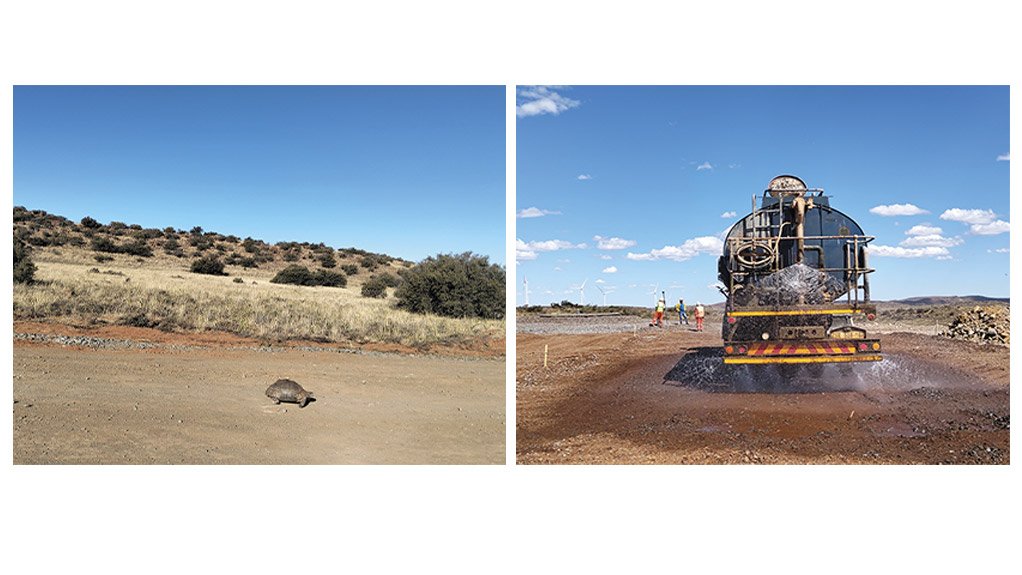


The Mulilo De Aar 2 South wind energy facility in the Northern Cape is one of Concor’s first fully wrapped balance of plant (BoP) contracts and the company says it has committed to going beyond compliance requirements to actively protect biodiversity in the area, managing resources responsibly and rehabilitating disturbed areas with the use of indigenous vegetation.
The environmental approach is guided by adherence to the project’s environmental authorisation, environmental management programme (EMPr) and other relevant permits and licences. Beyond regulatory compliance, Concor embeds best practice environmental management principles throughout the project. The project’s environmental officer Zimasa Nodangala says every activity on site - from dust and water control to waste management and heritage protection - is carefully managed to ensure the project leaves behind a stable, ecologically resilient landscape
“Environmental protection is not a box-ticking exercise for us,” she explains. “We see it as part of how we build - responsibly, ethically and in partnership with the environment. Every activity on site is managed to minimise impact, whether it relates to dust control, water conservation or biodiversity protection.”
The company says it has developed an aspects-and-impacts register aligned with the EMPr to identify and address environmental risks. “Dust suppression measures include restricting vehicle speeds on access roads to 40 km/h - and 20 km/h in unconsolidated areas - and using water carts for dust suppression. The project team has also implemented controlled blasting techniques to minimise both dust and fly rock,” Nodangala says.
Water usage is also a focus area and abstractions are authorised by the Department of Water and Sanitation, with daily monitoring through tally sheets and flow meters aimed at ensuring responsible consumption. Stormwater is also managed through the use of drainage systems designed to prevent erosion. “Our goal is to avoid sedimentation and protect surrounding ecosystems,” Nodangala notes. “By managing runoff carefully, we reduce the risk of environmental damage during heavy rainfall.”
Waste management is another component of the environmental protection strategy. Waste is segregated at source and transported to licensed landfill sites, with recycling implemented wherever possible. “We also ensure that hazardous substances are stored safely and that spill kits and drip trays are available at all times,” Nodangala says.
Concor asserts that protection of biodiversity has been a focus since the start of the project and that construction activities are confined to authorised servitudes to prevent disturbance of previously relocated species and sensitive habitats.
“Before construction began, a registered specialist conducted a search-and-rescue operation under project-specific permits,” explains Nodangala. “Indigenous vegetation was relocated where necessary and biodiversity awareness training was rolled out to every employee, subcontractor and supplier. Rehabilitation is done concurrently with construction so that we can restore disturbed areas as quickly as possible using indigenous plants. This helps stabilise soils, prevent erosion and promote long-term ecological resilience.”
Cultural heritage has also been managed and features of cultural significance are demarcated and protected. “Access to some of these sites was challenging at first, but they are now all labelled and designated as no-go areas,” she says. “We have also appointed gate minders and worked closely with local landowners to ensure mutual respect and understanding.”
Environmental performance is monitored through monthly environmental compliance reports, environmental control officer audits and quarterly health, safety and environment audits. In addition, all subcontractors and service providers undergo mandatory environmental induction before commencing work, with training offered in multiple languages.
“We want people to take ownership of their actions and understand that environmental care is part of their daily job,” concludes Nodangala.
Article Enquiry
Email Article
Save Article
Feedback
To advertise email advertising@creamermedia.co.za or click here



Latest Multimedia


Latest News


Showroom

Supplier & Distributor of the Widest Range of Accurate & Easy-to-Use Alcohol Breathalysers
VISIT SHOWROOM
Sika South Africa is a trusted partner for the nation’s infrastructure, commercial, residential, and industrial sectors.
VISIT SHOWROOM



Press Office
Announcements
What's On
Subscribe to improve your user experience...
Option 1 (equivalent of R125 a month):
Receive a weekly copy of Creamer Media's Engineering News & Mining Weekly magazine
(print copy for those in South Africa and e-magazine for those outside of South Africa)
Receive daily email newsletters
Access to full search results
Access archive of magazine back copies
Access to Projects in Progress
Access to ONE Research Report of your choice in PDF format
Option 2 (equivalent of R375 a month):
All benefits from Option 1
PLUS
Access to Creamer Media's Research Channel Africa for ALL Research Reports, in PDF format, on various industrial and mining sectors
including Electricity; Water; Energy Transition; Hydrogen; Roads, Rail and Ports; Coal; Gold; Platinum; Battery Metals; etc.
Already a subscriber?
Forgotten your password?
Receive weekly copy of Creamer Media's Engineering News & Mining Weekly magazine (print copy for those in South Africa and e-magazine for those outside of South Africa)
➕
Recieve daily email newsletters
➕
Access to full search results
➕
Access archive of magazine back copies
➕
Access to Projects in Progress
➕
Access to ONE Research Report of your choice in PDF format
RESEARCH CHANNEL AFRICA
R4500 (equivalent of R375 a month)
SUBSCRIBEAll benefits from Option 1
➕
Access to Creamer Media's Research Channel Africa for ALL Research Reports on various industrial and mining sectors, in PDF format, including on:
Electricity
➕
Water
➕
Energy Transition
➕
Hydrogen
➕
Roads, Rail and Ports
➕
Coal
➕
Gold
➕
Platinum
➕
Battery Metals
➕
etc.
Receive all benefits from Option 1 or Option 2 delivered to numerous people at your company
➕
Multiple User names and Passwords for simultaneous log-ins
➕
Intranet integration access to all in your organisation